Contents
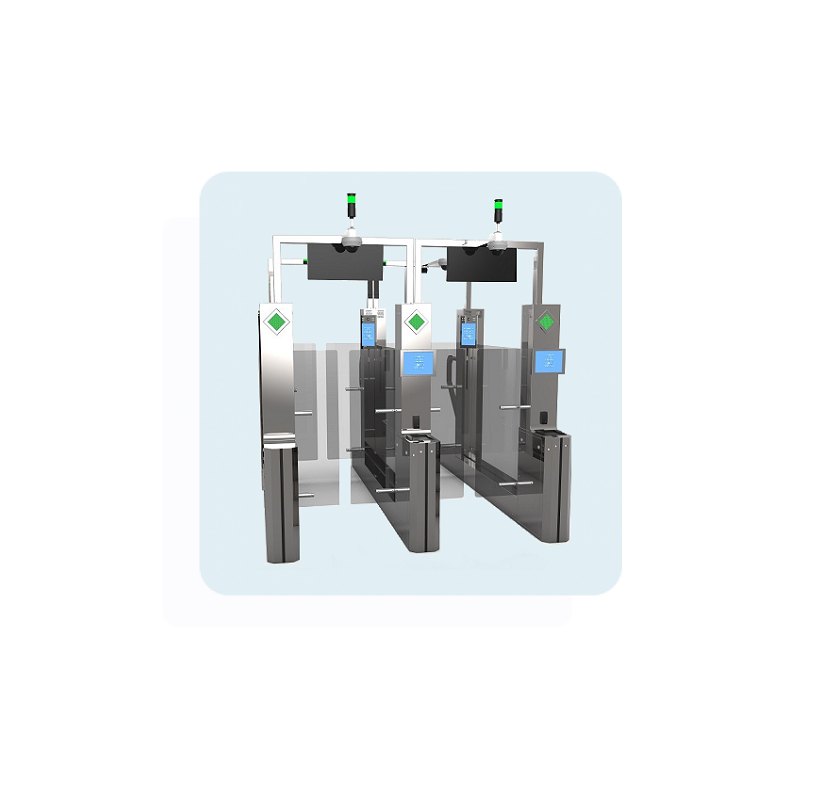
Automatic passage module (APM ASPK) — is a modern solution for automating passport control at border checkpoints. The APM ASPK allows passengers to go through the passport control procedure independently, increasing throughput capacity up to 5 times and reduces processing time down to 40-80 seconds.
For in-depth document authenticity verification, the system may use an automated workstation for special document verification (ARM SPD), while for mobile control in the field — the portable tool PTSPK. The product has successfully passed operational trials at international airports Domodedovo and Sheremetyevo.
The APM ASPK has certificates FSTEC of Russia and meets information security requirements for processing personal data and information constituting state secrets.
The APM ASPK modules are installed at border checkpoints and operate together with the automated passport control system (ASPK). The passenger independently presents their passport to the scanner; the module checks the document against databases and, if all checks pass, opens the turnstile.
Who is it for: border service, airports, sea and railway stations, checkpoints.
APM ASPK — is designed to enable a passenger to go through the passport control procedure independently at border checkpoints of the Russian Federation. It is a modern and ergonomic passenger assistant, a powerful and reliable border control tool that increases throughput capacity 5 times and reduces processing time at a checkpoint to 40-80 seconds.

|

|
Component set of the APM ASPK

|
|
Functions of the APM ASPK (Version 1 — one-way)
- Detection of a person standing in front of the APM ASPK;
- Step-by-step guidance for the passenger on the APM ASPK passage procedure;
- Obtaining information from the passport-visa document (PVD):
- Reading data from the machine-readable zone (MRZ);
- Data reading RFID-of the chip embedded in the PVD;
- Recognition of the PVD visual inspection zone;
- Automatic authenticity control of the presented PVD;
- Scanning of the boarding pass;
- Automatic check of the passenger's flight check-in;
- Automatic detection of more than one person inside the cabin;
- Alarm on climbing-over attempt;
- Obtaining the passenger's photo image and scanning fingerprints;
- Automatic comparison of biometric information from RFID-the chip with images obtained from fingerprint scanner and photo camera (multi-factor verification). For fingerprint identification we also offer the system «Biomark», and for face recognition — «Biovizum»;
- Biometric identification using high-precision algorithms;
- Authenticity check of biometric objects presented by the passenger (fake detection);
- Notifying the APM ASPK operator about a detected discrepancy during the current check;
- Emergency door opening, door blocking, alarm button;
- Automatic detection of abandoned items;
- Remote monitoring of all components;
- Providing continuous video recording capability;
- Information exchange with the central hardware-software complex.
The passport control procedure — is a time-consuming and labor-intensive process. A border service officer cannot always quickly process a large, continuous flow of passengers. Placing a second border service officer nearby is not always possible, yet throughput capacity must be increased. In such a situation, APM ASPK modules come to the rescue; they can operate in parallel in unlimited numbers.
The APM ASPK reads data from documents, verifies it against the face of the person presenting them, and records the fact of crossing the border directly into the database. The border service officer only needs to respond to the small percentage of cases where the APM detects discrepancies and reports them.
The computer vision algorithms implemented in the APM ASPK allow detecting several people inside the gateway cabin and identifying a person by face and fingerprint.
Key characteristics of the APM ASPK
| APM weight (net) | 500 kg |
| APM corridor width | 900 mm |
| Overall dimensions | 3431×1403×2781 mm |
| Supply voltage | 220 V |
| Power consumption | no more than 800 W |
The APM ASPK supports the concept of whitelist: the module can be configured so that passage is possible without presenting documents.
The APM ASPK design is an optimal balance between the lightness and simplicity of its appearance and the robustness of its filling as a border line. All mechanical parts of the APM are made entirely of domestically produced materials manufactured in our country.
Automatic diagnostics and redundancy of all APM ASPK components prevent it from failing unnoticed in the middle of the working day, while manual diagnostics are minimized.
Related products and services
- APM ASPK Version 2 (two-way)Two-way configuration of the device
- ADIS BiomarkFingerprint identification
- ASRL BiovizumFace recognition
- Design and development of automated information systemsCreation of secure automated systems
- Installation and commissioningEquipment installation and configuration
- Staff trainingWork with the passport control system
Related technologies
- Server virtualizationVirtualization technologies for passport control
- Unified information security systemData protection for passport control