
Sommaire
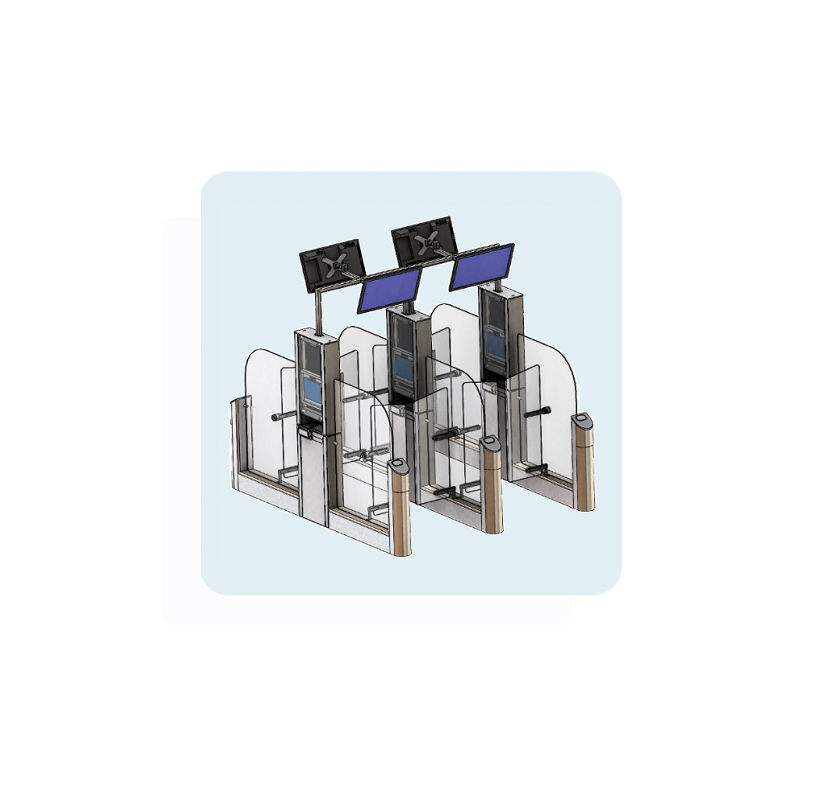
Automatic passage module (APM ASPK) — is a modern solution for automating passport control at border checkpoints. The APM ASPK allows passengers to go through the passport control procedure independently, increasing throughput capacity up to 5 times and reduces processing time down to 40-80 seconds.
Pour une vérification approfondie de l'authenticité des documents, le système peut utiliser an automated workstation for special document verification (ARM SPD), while for mobile control in the field — the portable tool PTSPK. The product has successfully passed operational trials at international airports Domodedovo and Cheremetiévo.
The APM ASPK (Version 2) is certified FSTEC de Russie and can be used at facilities requiring an enhanced level of security.
Two-way APM ASPK modules are installed at checkpoints with combined entry and exit zones. The passenger independently presents their passport to the scanner; the module checks the document against databases and, if all checks pass, opens the turnstile.
Pour qui : border service, airports, sea and railway stations, checkpoints.
APM ASPK — is designed to enable a passenger to go through the passport control procedure independently at border checkpoints of the Russian Federation. It is a modern and ergonomic passenger assistant, a powerful and reliable border control tool that increases throughput capacity and reduces processing time.
Designed for:
- Installation at checkpoints with combined border control zones for entry (arrival) and exit (departure);
- Use in conditions of large passenger flows and optimization of staff performing passport control;
- Increasing passenger satisfaction;
- Access control and management systems for restricted facilities and territories.
Component set
- Gateway cabin
- Biometric document reader
- Boarding pass scanner
- Fingerprint scanner
- Verification photo camera
- Abandoned item detectors
- Video analytics sensors for passenger passage control
- Information monitors (guide the passenger through the required steps during passport control)
- Intercom device
- Alarm button
Unique set of options
- Automatic authenticity control of the presented biometric identity document
- Passenger flight check-in control
- Multi-factor verification (biometric passport + fingerprint + face photo from video stream)
- Set of covert authenticity tests for biometric objects presented by the passenger (fake detection)
- High-precision algorithms biometric identification
- Ergonomics and passenger convenience, intuitive set of actions, hints
- Automatic detection of abandoned items
- Automatic detection of more than one person inside the cabin
- Remote monitoring of all components of APM hardware-software modules
Key characteristics
| Poids de l'APM (net) | 600 kg |
| Largeur du couloir APM | 1000 mm |
| Overall dimensions (L×W×H) | 3150×1203×2700 mm |
| Tension d'alimentation | 220 V |
| Consommation électrique | no more than 1000 W |
Operating principle
The APM ASPK is a gateway cabin with a central corridor and metal racks on the sides. The rack housings are protected against tampering and ingress of foreign objects into the interior of the cabin.
The APM has two doors — entry and exit.
In front of the entry door are:
- Sensors for detecting a passenger in front of the document scanner;
- Information monitor;
- PVNPD reader;
- Boarding pass scanner;
- Passage status light indicators
Inside the APM (between the doors) are:
- Photo camera;
- 3D camera;
- Audio system combined with a signaling alarm button;
- Information monitor;
- Fingerprint scanner
It should be noted that the high scientific and technical potential inherent in the APM ASPK allows its use not only in the interests of border control, but also in the service of customs authorities, internal affairs bodies, migration services, and in the activities of security services of important facilities.
Produits et services associés
- APM ASPK Version 1 (one-way)One-way configuration of the device
- ADIS BiomarkIdentification par empreintes
- ASRL BiovizumReconnaissance faciale
- Conception et développement de systèmes d'information automatisésCréation de systèmes automatisés sécurisés
- Installation et mise en serviceInstallation et configuration des équipements
- Formation du personnelTravail avec le système de contrôle des passeports
Technologies associées
- Virtualisation de serveursTechnologies de virtualisation pour le contrôle des passeports
- Système unifié de sécurité de l'informationProtection des données pour le contrôle des passeports